Review: Batman #150 - "Be Better"
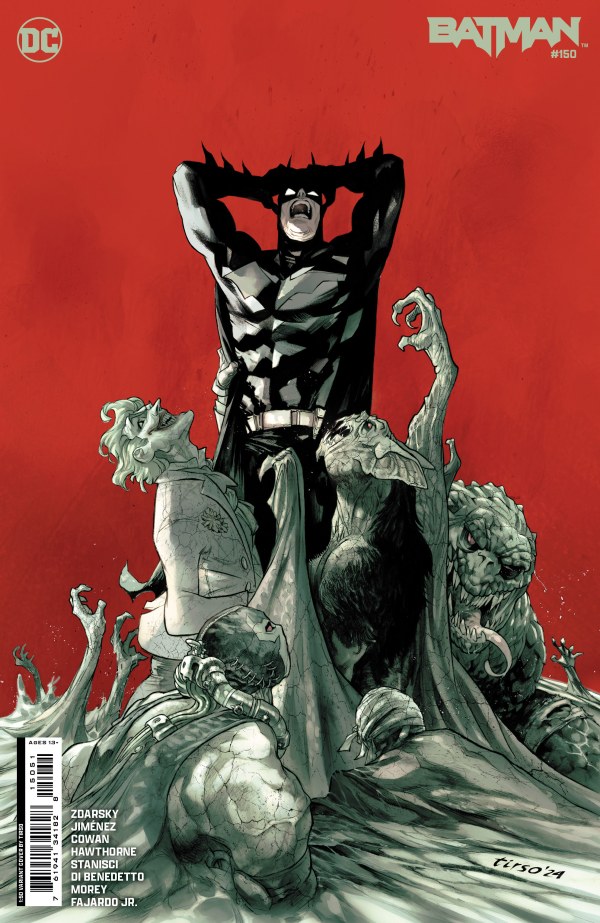
Written by: Chip Zdarsky Art by: Denys Cowan (main story), Jorge Jiménez (main story), Mike Hawthorne (backup story) Inks by: John Stanisci (main story) Colors by: Tomeu Morey (main story), Romulo Fajardo Jr. (backup story)
Batman #150, a celebratory issue in the 2016 Dark Knight series, turns out to be a surprising and deeply human work, thanks to Chip Zdarsky’s writing. Far from classic epic showdowns, this issue focuses on a more intimate and thoughtful story, using supporting characters to explore Batman’s true impact on Gotham and the minds of its inhabitants.
The narrative opens in a bar, where Teddy Critchley, a former henchman of Catwoman, confides in his friend and bartender Flannigan that he’s discovered Batman’s true identity. Teddy is broke and desperate, seeing this information as his only way out. Flannigan, however, tries to talk him out of it, recounting a past anecdote: one night, finding Batman lying helpless on the ground, he witnessed his sudden, almost demonic “awakening,” which terrified the onlookers. This episode immediately highlights the veil of mystery and awe surrounding the Dark Knight in Gotham. His mask, more than a simple disguise, is a powerful and, in a way, vital symbol.
A Burning Secret: Teddy’s Journey
The scene shifts with the arrival of Percy, another friend of Teddy’s, who downplays Flannigan’s fears: Batman is just a man, and his secret is valuable merchandise. The two toast to their future wealth, unaware of the complex web of consequences they’re about to unleash.
The next day, Teddy’s wake-up is jarring, marked by an argument with Kim, the mother of his son Yuto. Kim accuses him of being an irresponsible dreamer, unable to support the family or pay attention to their son, who Teddy discovers is about to move away. This confrontation frames Teddy’s desperation and his motivation to monetize the information.
Accompanied by Percy, Teddy meets their first contact: Two-Face. The villain reveals he already knows Batman’s identity, casting a shadow of doubt on the reader’s perception: is it true, or a strategy to discourage Teddy? Two-Face argues that a “pure” Batman (a reference to Zdarsky’s earlier “Zur-En-Arrh” storyline in his run) would strip them of their very reason for being, their “beautiful” struggle. This conversation is a crucial point, highlighting how Batman’s secret identity is a fundamental element in the (albeit distorted) balance of Gotham’s criminal ecosystem.
Shortly after, as Teddy and Percy leave the meeting, they notice Batman observing them from above, implying that news of the secret is already spreading like wildfire. Their next meeting is with the siblings Aiden and Addison Cobblepot, at their casino inherited from Oswald. Teddy demands a million dollars. Here too, Batman is present, his shadow confirming to the Cobblepots the truthfulness of Teddy’s claims.
But just as victory seems within reach, Roger, a former associate of Teddy’s, intervenes with a group of other “ henched” (former henchmen) whom Teddy knows: Cutup, Ahmad, Belle, and Darren. Roger warns them that the Cobblepots would kill Teddy after getting the secret. This group wants Teddy’s information, but not immediately. Their plan is to exploit his knowledge for a bank heist, believing Batman won’t intervene to avoid risking Teddy and his secret. Belle, in particular, reassures Teddy about Batman’s morality, telling him how the hero even saved her from Mr. Freeze.
Naturally, the bank heist fails at Batman’s hands. Stunned and taken away, Teddy wakes up in an unfamiliar room, only to find himself face to face with his son, Yuto.
Redemption and Batman’s “Be Better”
The dialogue between Teddy and Yuto is the emotional core of the comic. Yuto, a student at Gotham University (which Teddy didn’t know about), expresses all his disappointment in his father, his ties to crime, and his fear of facing reality. In response, Teddy accuses him of affording his studies with “easy money.” This is where Yuto reveals the truth that changes everything: one night, trying to imitate his father, he offered himself as a henchman for Scarecrow. During a clash with Batman, Scarecrow’s fear toxin hit him, causing intense anxiety and a racing heart, but luckily the formula wasn’t fully complete, and Yuto got off lightly. He wonders how his father could live these nightmares every night, risking not returning home and leaving him an orphan and his mother a widow.
The plot twist is powerful: during that clash, Batman had pulled Yuto out of the fray, getting him to safety. At that point, in silence, he had listened to the boy’s entire confession. Sensing that Yuto wasn’t cut out for that life and perceiving his true desires, Batman approaches him, extends a hand, and listens to him like no one ever had. Once Yuto explains his dreams and what he wants to do with his life, Batman encourages him to apply to Gotham University, taking on the expenses himself. When Yuto asks what he wants in return, Batman’s answer breaks him with its simplicity and power:
“Be better.”
The final pages show Teddy face to face with Bruce Wayne. Having understood the lesson, Teddy knows he can no longer reveal the secret. Bruce offers him a way out: go to Metropolis and start a new life. Teddy leaves on a bus, departing Gotham and his dangerous secret, hoping to one day return and embrace his son.
The Concepts Analyzed by Chip Zdarsky
In this significant and introspective issue, Zdarsky masterfully analyzes several fundamental concepts, elevating the story far beyond a simple superhero adventure:
The Father-Son Relationship and the Crisis of the Paternal Figure: The comic explores a son’s disappointment in an absent and irresponsible father. Yuto, despite admiring the figure he thought his father was, confronts the harsh reality of his failures. Zdarsky shows how, as they grow up, a child learns to distinguish right from wrong, and how the weight of expectations and disillusionments can forge their character. Batman’s figure intervenes here not as a “ punisher” but as a silent mentor who offers Yuto a chance at redemption that his father couldn’t provide. It’s a poignant commentary on parental responsibility and the lasting impact of a parent’s choices on their children.
Batman’s Morality and Redemption: This issue is a powerful example of how Batman isn’t just the “classic brawler” or merely a detective. Zdarsky delves into Bruce Wayne’s psychological depth, revealing a more compassionate and rehabilitation-oriented side. The “Be better” mantra isn’t just directed at Yuto; it’s a universal message and the underlying philosophy of Batman himself. It demonstrates his commitment not only to fighting crime but also to “ saving” individuals, offering them the possibility of a better life, even those who have made mistakes or questionable decisions like Teddy. It’s a vision of Batman as a force for positive change in his city, a beacon of hope that pushes even the marginalized to seek redemption.
The Impact of the Mask and Secret Identity: Zdarsky explores the value of Batman’s mask as a symbol. It’s not just a way to protect Bruce Wayne; it’s crucial for his effectiveness as a vigilante. The reaction of Gotham’s criminals to the potential revelation of Batman’s identity, including Two-Face and the “henched,” highlights that his secret identity is an integral part of the city’s balance. The legend and mystery surrounding Batman make him an almost supernatural force, something that goes beyond the man, allowing him to instill fear and inspire hope in ways Bruce Wayne could never do alone.
The Cycle of Crime and the Possibility of Breaking Free: Teddy’s story, following the path of “easy money” and getting caught in a vicious cycle, represents the many ordinary people involved in Gotham’s criminal underworld. Zdarsky shows how difficult it is for these individuals to break the cycle. Batman’s role in this context isn’t just to “stop them” but to offer a concrete alternative. The opportunity given to Teddy to start over in Metropolis is a symbol of this hope, a sign that change is possible, even if it requires a radical abandonment of one’s past and environment.
Batman #150 by Zdarsky is a powerful and moving statement about the true meaning of Batman’s heroism. It’s not just about stopping the bad guys, but about believing in the possibility that anyone, even the smallest and most flawed, can “be better.”